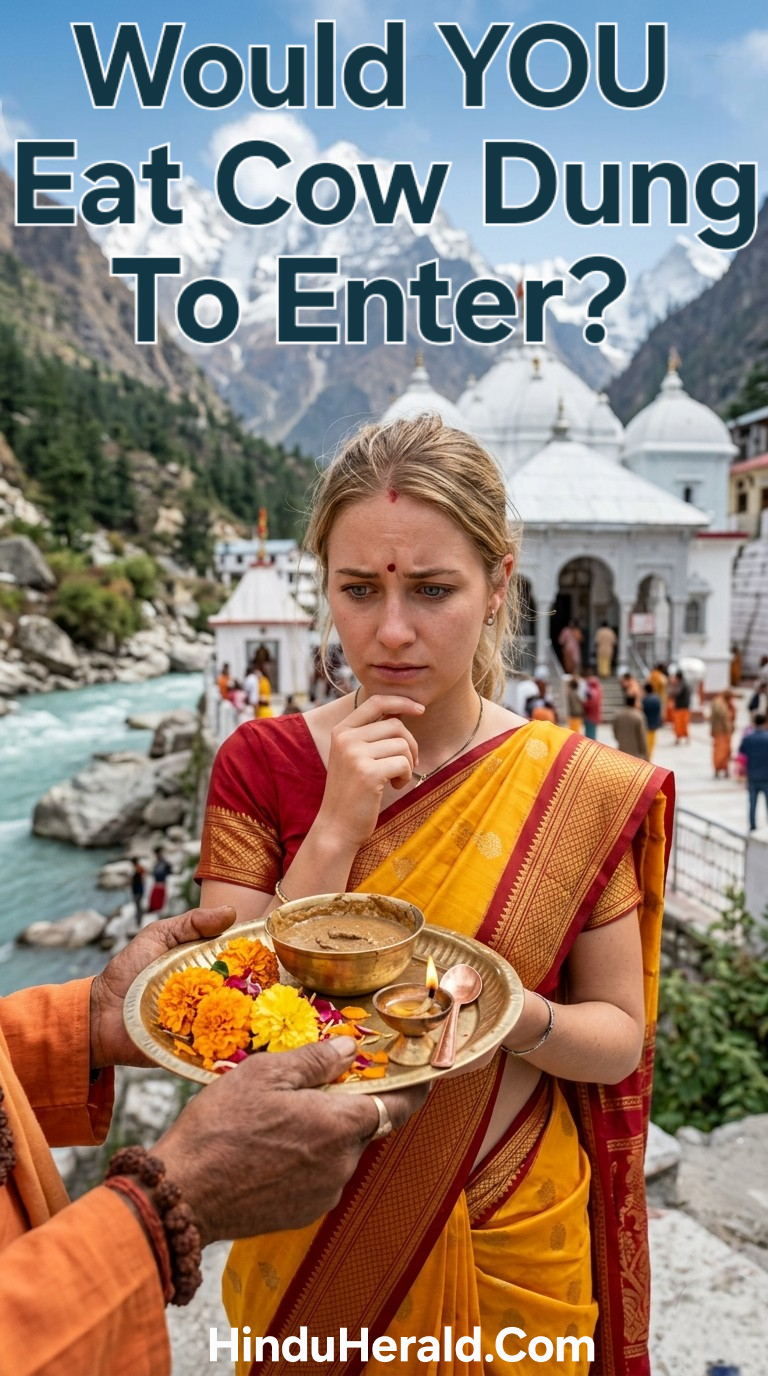
GANGOTRI DHAM BANS NON-HINDUS UNLESS THEY EAT PANCHGAVYA COW DUNG FIRST!
While Yamunotri says: all devotees welcome.
🚨 The Gangotri Temple Committee has made it official: non-Sanatanis who wish to enter Gangotri Dham must first consume Panchgavya — a sacred mixture that includes cow urine and cow dung. No consumption, no entry.
This is not a rumour. This is not a proposal still under discussion. According to multiple sources including News18 and News9, the Gangotri Temple Committee has decided this rule. A Supreme Court lawyer has been brought in to work out the legal framework. The Char Dham Yatra opens April 19. The clock is ticking.
And in a dramatic twist that no other outlet is leading with — Yamunotri Dham has broken ranks entirely.
Hindu Herald is asking the questions the other outlets won’t.
🐄 WHAT IS PANCHGAVYA — AND WHAT EXACTLY IS IN IT?
Panchgavya (“pancha” = five, “gavya” = cow substances) is a traditional preparation used in certain Hindu purification rituals. The classical Vedic formulation — the one with actual scriptural basis — contains these five ingredients:
- Milk
- Curd (yogurt)
- Ghee (clarified butter)
- Cow urine (gomutra)
- Cow dung (gomaya)
Worth noting: some reports suggest the Gangotri committee’s version substitutes Ganga water and honey for curd and ghee — apparently making the mixture more palatable. But the cow urine and cow dung remain in every version being reported.
So if the committee is modifying the classical recipe to make it easier to swallow, a pointed question arises: if the ancient formulation needed changing, how sacred is the test? You cannot claim ancient authority for a modified ritual.
⛰️ THE UTTARAKHAND CRACKDOWN: BIGGER THAN YOU THINK
The Gangotri decision does not exist in isolation. A sweeping movement is underway across Uttarakhand’s entire sacred geography simultaneously.
The Badrinath-Kedarnath Temple Committee has passed a formal resolution banning non-Hindus at both those dhams, requiring any exceptions to sign an affidavit of faith declaring belief in Hinduism. The Ganga Sabha has demanded a ban on non-Hindu entry at over 100 Ganga ghats in Haridwar and Rishikesh. And now Gangotri has gone further than all of them — moving from a ban to a compulsory ritual ingestion test.
Three of the four Char Dhams are now moving in the same direction. Every major sacred site in Uttarakhand is tightening access at the same time, just weeks before the Yatra opens.
🕊️ YAMUNOTRI BREAKS RANKS — AND INVOKES VASUDHAIVA KUTUMBAKAM
Here is the story within the story — and it is extraordinary.
While Gangotri, Badrinath and Kedarnath move toward restriction, Yamunotri Dham has taken the opposite position entirely. The Yamunotri Temple Committee issued a formal statement this week declaring that every devotee who comes with faith will be welcomed at Yamunotri — regardless of religion. Committee spokesperson Purushottam Uniyal invoked the ancient principle of Atithi Devo Bhava (the guest is like God) and Vasudhaiva Kutumbakam (the world is one family).
Treasurer Pradeep Uniyal went further, saying the committee’s role is to serve devotees — not to police their faith.
So the four Char Dhams are now split. Three are building walls. One is opening its arms. Both are claiming to represent Sanatana Dharma. They cannot both be right.
🔍 IMPORTANT DISTINCTIONS THE COMMITTEE MADE
Gangotri committee secretary Suresh Semwal specifically stated that Sikhs and Jains are considered within the Hindu religious fold for the purposes of this rule. They are exempt from the Panchgavya requirement.
Buddhists were not mentioned. That silence is its own statement.
Meanwhile, a newly appointed Uttarakhand Cabinet Minister, Khajan Dass, has broken with the government’s otherwise cautious silence, saying publicly that dividing people in the name of religion is not right and risks damaging Uttarakhand’s social harmony.
📜 WHAT DO THE AGAMAS ACTUALLY SAY?
Here is where this decision runs into serious theological trouble — and where every Hindu who cares about shastra pramana (scriptural authority) needs to pay attention.
The Agamas — the foundational scriptural texts governing temple worship across Shaiva, Vaishnava, and Shakta traditions — are detailed and specific about who may and may not enter a temple. The criteria are consistent across traditions:
Who is eligible for entry? Those who are shuddha (ritually clean — bathed, properly attired), respectful of the deity, and not hostile to the faith.
Who may be restricted? Those in states of ritual impurity, those who mock the deity, or those who intend harm or disruption.
But here is what no Agama says — not one: “Make a visitor consume a substance to prove their eligibility.”
Agamic tradition requires external purity (bath, clean clothes) and internal bhava (devotion, reverence). Even the most strictly regulated temples in India — Guruvayur in Kerala, Jagannath Puri in Odisha — may deny entry to non-Hindus. That is entirely within temple autonomy. But denial of entry is categorically different from compelled ritual ingestion.
The Gangotri committee has not cited a specific Agama or verse that authorizes this practice — because none exists. If they believe otherwise, Hindu Herald invites them to publish the citation. We will cover it.
🤔 A QUESTION OF SAMPRADAYA
One more theological point the committee has not addressed. Cow reverence — go-puja — is most deeply embedded in the Vaishnava sampradaya. Bhagavan Krishna was a cowherd. Cow protection flows naturally from Vaishnavism’s theological core.
But Gangotri Dham is dedicated to the Ganga — a Shaiva-adjacent, non-sectarian pilgrimage site belonging to all Hindus. Using distinctly Vaishnava standards to set entry rules for a non-sectarian dham is a theological imposition that the committee has not justified.
Meanwhile, Yamunotri — which has chosen inclusivity — is invoking principles found across all Hindu traditions: Atithi Devo Bhava and Vasudhaiva Kutumbakam. Which temple is actually drawing on the deeper well of Sanatana Dharma?
❓ WE ARE ASKING THE QUESTIONS OTHERS WON’T
Hindu Herald wants to hear from you:
❓ Gangotri says eat cow dung or stay out. Yamunotri says all devotees are welcome. Both claim to represent Sanatana Dharma. Which temple is right?
❓ No Agamic scripture authorizes consuming a substance as a test for temple entry. Should a rule with zero scriptural basis stand at one of Hinduism’s holiest shrines?
❓ The committee exempted Sikhs and Jains as part of the Hindu fold. Buddhists were not mentioned. What is the Gangotri committee’s position on Buddhists?
❓ Cow reverence is most central to the Vaishnava tradition. Is it appropriate to impose Vaishnava standards at Gangotri Dham — a shrine that belongs to all of Sanatan Dharma, not one sampradaya?
❓ The Char Dham Yatra draws nearly five million pilgrims a year and is a major economic engine for Uttarakhand. What happens to that economy if non-Hindu visitors — many of them tourists spending money in local communities — are turned away?
❓ Is the Panchgavya test protecting dharma — or does Yamunotri’s Atithi Devo Bhava better represent the soul of Hinduism?
Drop your answers in the comments. This conversation needs to happen.
Sources: News18 | Organiser | ETV Bharat | News9
© Hindu Herald — All Rights Reserved
About the Author