🚨 The Pashupati Seal is from IRAN?
Historian Audrey Truschke recently argued that the famous Pashupati Seal is not Shiva and may reflect Iranian influences — setting off a fresh storm online!
At the center of the debate is the Pashupati Seal, a 4,000-year-old artifact from the Indus Valley Civilization that many Hindus view as one of the earliest depictions of Lord Shiva.
To support her claim, Truschke pointed readers to a controversial 1984 paper by German Indologist Doris M. Srinivasan titled “Unhinging Shiva from the Indus Civilization.” In that paper, Srinivasan argued that the famous meditating figure on the seal is not Shiva at all.
But what does the evidence actually show?
We at the Hindu Herald went down the rabbit hole, examined the arguments from both sides and broke the entire controversy down in plain English. We’ll look at Srinivasan’s paper, the Iran connection, the trident-like headdress, the posture, the face, the animals, and the broader question of whether the seal has any connection to the later Shaivite tradition.
This article is divided into 3 main sections:
1) Examining Audrey Truschke’s claims
2) Examining Doris M Srinivasan arguments
👥 What’s The Indus Valley Civilization?
The Indus Valley Civilization (IVC) were the people of ancient India. They lived in North West Afghanistan, most of Pakistan and Northwestern India. It was a thriving civilization. The IVC existed between 3300 BCE (before common era) and ended roughly in 1300 BCE. No one knows what happened to them and their language & script are to this day – undeciphered! Archeological remains of the Indus Valley are found at Harappa (Punjab), Mohenjo-daro (Sindh, Pakistan), Rakhigarhi (Haryana). The 2019 Rakhigarhi excavation found the DNA of the Indus Valley people has Iranian related ancestry and South Asian hunter gatherer ancestry. In other words ancient Iranian & ancient Indian.
📚 What’s The Vedic Era?
The Vedic era started AFTER the Indus Valley Civilization (IVC) ended. These are the people who wrote the Vedas.
Vedic era DNA was studied by V. Narasimhan in the 2019 Swat Valley excavation. That’s in modern day Pakistan. Samples dating from 1200 years BCE show Steppe ancestry (Central Asian) and AASI – Ancient Ancestral South Indian. Modern day people descended from the Brahmin caste have higher amounts of Steppe (Central Asian) ancestry. No Steppe ancestry in IVC.
So to recap plainly:
Indus Valley = Iranian related / Indian
Vedic era = Central Asian / Indian
🗿 What’s The Pashupati Seal?
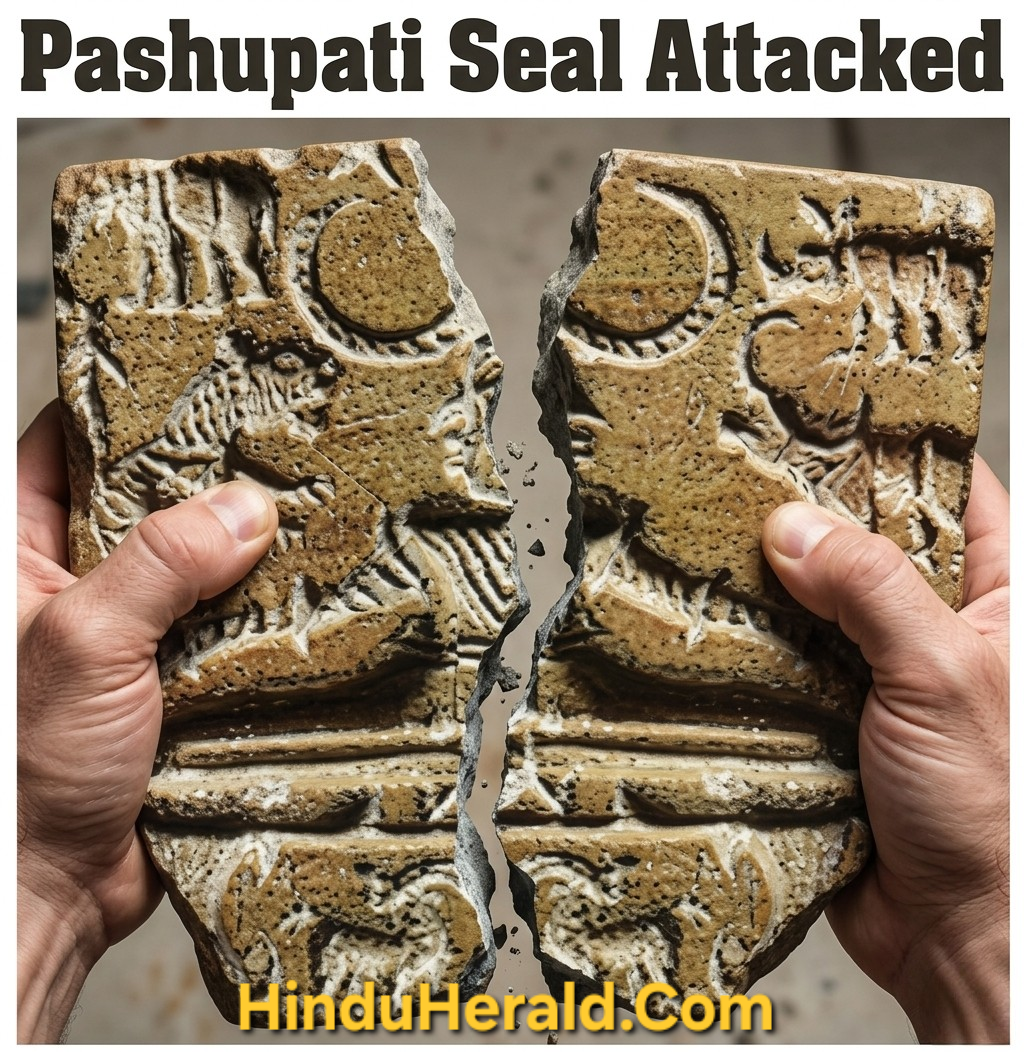
During archeological excavations in 1928 at Mohenjo Daro (present day Pakistan) where the Indus Valley people lived – an ancient seal was found depicting what appeared to be a 3 faced man sitting in a yogic posture, wearing a horned headdress surrounded by animals. English archeologist, John Marshall said the seal was a prototype of the Hindu God, Shiva as “Pashupati” – lord of animals.
🤯 What’s The Audrey Truschke Pashupati Seal Row About?
🗣️ Pakistan Brags
Lately Pakistan has been claiming that the Indus Valley Civilization is a part of Pakistani heritage because large parts of the Indus Valley are in modern day Pakistan. Pakistan was only founded in 1947.
✋ India Responds
In response to this, the Indian Ministry Of Culture put out a tweet on X saying that modern day India is the “unbroken civilizational continuity” of the Indus Valley Civilization. The Indian Ministry Of Culture also put up a pic of the Pashupati Seal found at Mohenjo Daro (Pak) & said it’s the Hindu God, Shiva – worshipped predominantly in India.
💣 Enter Audrey Truschke
Controversial USA Professor, Audrey Truschke, watching the war of words between the two countries play out, then tweeted,
“This isn’t Shiva. It’s more likely adapted from proto-Elamite iconography, showing an Eurasian deity ‘lord of animals.’ “
Elam is ancient Southwestern Iran and Elamite refers to the ancient people & extinct language. So Truschke is saying it’s an ancient Iranian seal.
📃 1984 Article Dragged In
Audrey Truschke then cited a long forgotten 1984 article called, “Unhinging Shiva from the Indus Civilization” by German Indologist, Doris Meth Srinivasan. The article appears in the Journal Of The Royal Asiatic Society. The article is a hit piece on Lord Shiva that seems to go out of its way to disprove that Shiva is the subject of the Pashupati Seal. Doris M. Srinivasan is a White woman who married a Vaishnava Indian man. They went through a nasty divorce complete with a court fight over money & property. At the time she wrote the article trying to disprove Shiva, she was still married to her Vaishnava husband.
🏫 Rutgers Connection
Audrey Truschke is a historian at Rutgers University in New Jersey and Doris Srinivasan’s ex husband used to be a tenured professor at Rutgers.
🔎 Examining Audrey Truschke’s Claims
First, we at the Hindu Herald are neither historians, indologists or archeologists. We’re civilians. That said, let’s get into it.
📜 Qualifications
Audrey Truschke is a Professor of South Asian history. She specializes in Medieval history and the Mughals. She does NOT specialize in the Indus Valley Civilization.
❓ Fact Or Opinion?
Audrey Truschke said: “This isn’t Shiva. It’s more likely adapted from proto-Elamite iconography, showing an Eurasian deity ‘lord of animals.’ “
The phrase, “This isn’t Shiva” comes across as an established fact – when it’s NOT. It’s just Audrey Truschke’s opinion.
🦏 No Rhinos In Elam!
Now let’s move on to the second part of her sentence. Truschke said: “It’s more likely adapted from proto-Elamite iconography showing an Eurasian deity ‘lord of animals’ “
“Elamite” is ancient Southwestern Iran.
Here’s why the seal can’t possibly be proto Elamite. The animals surrounding the figure are an elephant, tiger, rhinoceros, water buffalo and deer. Rhinoceroses were not native to Elam, and they are not a common feature of known Elamite art. Their presence on the seal fits the native animals of the Indus region far better than that of southwestern Iran.
🐴 No God Of Animals!
The Elamite pantheon of Gods has no dedicated God Of Animals.
Audrey Truschke never explains WHY it’s Elamite.
⚽ Audrey Throws The Ball To Doris
Audrey Truschke next cited a long forgotten 1984 article by German indologist, Doris Meth Srinivasan. The article appeared in the Journal Of The Royal Asiatic Society with the scandalous title, “Unhinging Shiva From The Indus Civilisation”. The Srinivasan article re-examines archeologist John Marshall’s 1928 claim that the Pashupati Seal is a proto Shiva. She dissects every aspect of the seal to try and prove it’s not Shiva. Does she succeed?
No.
This all boils down to a HE SAID, SHE SAID between 2 people: archeologist, John Marshall (who said it was Shiva) & indologist, Doris M. Srinivasan (who denies it). Let’s talk about Doris M. Srinivasan’s findings.
🔎 Examining Doris Srinivasan’s Claims
🔱 Headdress
1) Srinivasan says the headdress on the Pashupati Seal is horns with a branch not a trishul. She said other figures were found at Kalibangan with that same horns & branch headdress so they all can’t be Shiva.
The trishul as we recognize it today was developed over time. Expecting a 4,000+ year-old seal to show a fully rendered classical trishul is anachronistic. Symbols evolve. That’s not evidence against identification, it’s just how art history works.
Perhaps horns & a branch was their way of making a trishul? Similar to on Palm Sunday when crosses are made with palm leaves.
Shiva wears the crescent moon on his head. A curved projection. Across early iconographic traditions, divine headgear involving projections (horns, crescents, branches) signals the same category of deity. The “it’s just horns and a branch” argument doesn’t disqualify Shiva – it describes Shiva-type iconography from an earlier period.
Just because others wore a similar headdress doesn’t mean the original isn’t authentic. Example – Shaivites wear matted hair, rudraksha, ashes, so they resemble Shiva. If you find a Shiva murti and statues of Shaivites – they’d resemble each other. Doesn’t mean the first isn’t Shiva.
🧔 Face Of The Seal
Srinivasan says that the face of the Pashupati Seal is a half man, half bull – not 3 faces. She says the side projections on the face may not be extra faces but the ears of a bull. She said face has double line suggesting loose skin like dewlap of bull. Humanized bull heads also found elsewhere.
– Lord Shiva has an incarnation called Nandi: a half man, half bull.
– Lord Shiva incarnates as a bull, Vrishaba, in the story where he goes down to the netherworld to get Vishnu.
– In a regional retelling of the Mahabharat, when Pandavas try to meet Shiva, he turns into a bull & goes into the Earth.
– Mahishasura, the demon who Goddess Durga killed was a half man, half bull.
Saying the face is a bull is Srinivasan’s opinion, nothing more.
🧘 Posture
Srinivasan said the posture appears yogic but may just be the way people sat.
It may also be a yogic posture. The heels up against the groin is an advanced tantric technique. Shiva is the God who invented tantra. Shiva is called Adi Yogi – the first yogi.
⬆️ Phallus
Srinivasan said the possible phallus symbol may just be the end of a waistband.
It may also be what John Marshall suspected it was, a possible phallus and Lord Shiva is worshipped via a phallic lingam (though a phallus is not the original meaning. I’ll get to that later)
🦬 Animals
Srinivasan said the animals are: elephant, rhinoceros, buffalo, tiger. There’s also deer under the seat. She says animals not automatically Shiva as Pashupati.
These animals are connected to Lord Shiva.
– Lord Shiva wears an elephant skin
– Shiva sits on a tiger
– Nandi his mount is a bull with horns similar to buffalo.
– Some depictions of Shiva show him holding a deer which represents the mind.
– Classic asana (seat) was made of kusha grass or deer skin.
🏹 Vedic Pashupati
Srinivasan said that Vedic “Pashupati” only protects domestic animals not wild ones. She said Rudra may injure the animals.
This is patently untrue. One of Shiva’s 108 names is “Pashupati” which means the lord of animals. It doesn’t say Lord of only domestic animals but lord of animals. There’s no disqualifier in the name that says “only domestic”.
Furthermore the Rudram is a prayer to Rudra in the Krishna Yajur Veda. Rudram 2.8 describes Rudra as the Lord of the forest. What’s in the forest – wild animals. So why would Rudra injure animals that he’s the Lord of?
Moving on to the Indus Valley Civilization’s conical objects that John Marshall compared to Shiva Lingams:
🌊 Lingams In Streets & Drains
Srinivasan said that the Lingams were found in streets & in drains, not enshrined in rooms.
Last I checked, Hindus have pandals that are on the STREETS where lingams and murtis are placed. Some Shiva lingams *to this day* are placed in river water permanently so the water element will constantly wash over it – as an act of worship.
🖼️ IVC Lingams Were Abstract (plain) & Vedic lingams Were Phallus Like
Srinivasan said Indus stones that resemble lingams were ABSTRACT not phallic like. She pointed out that early Shiva lingams of the Vedic era were more PHALLIC like, then gradually became abstract. (so from phallus to pillar like) She reasoned that if the Vedic civilization was continuing lingam worship – then their lingams would match the way the Indus Valley lingams looked – plain, not like a male organ.
Indus Valley Civilization and the Vedic Civilization were two separate civilizations – according to archeologists. So their lingams would’ve looked different. A car from 1920 will not look the same as a car from 2026.
It’s like a cross necklace with a deceased Jesus sculpted on it compared to a cross as two plain pieces of metal. They both mean the same thing although they look different.
Even in 2026 modern day India, Shiva lingams don’t all look alike. Example – In Nepal they worship a lingam with Sada Shiva’s 5 faces carved onto all 4 sides and the top. At Mahakaleshwar Temple, they draw one face on the lingam with ash, in South India it’s a black lingam with tripundra lines and in stores they sell plain lingams in all colors, designs (with or without snake) and sizes. You can get Bana lingams, gem cut lingams, stone lingams. How are you going to fault the Vedic era for having different looking Shiva lingams when even today all lingams don’t look alike?!
Shiva Purana, Vidyeshvara Samhita, 5:11 says that the lingam represents the FORMLESS aspect of God. (As such, the lingam will not be carved like a phallus). This lines up with how the Indus Valley Civilization’s lingams looked – plain, pillar like.
Yes, early Shiva lingams after the Vedic era are phallus like but the Shiva Purana itself says the lingam represents
1) formless aspect of God,
2) God as a pillar of fire (Brahma & Vishnu argued, Shiva turned into a pillar of fire to end the fight).
People do carve lingams as phallus looking due to another story but that’s not the ORIGINAL meaning of the lingam as per Shiva Purana.
🔥 After IVC decline, Lingams Not Present In N. India For 1,600 years!
Doris Srinivasan said after the decline of the Indus Valley Civilization in 1900 BCE – lingam worship was not present in north India for 1,600 years. No early lingams found in NW India: Sind, Punjab, Hindu Kush, southern Bactria, Indo-Iranian borderlands. She says if Indus stones were lingams, you’d see evidence of lingams after Indus Valley.
Vedic civilization came after the Indus Valley Civilization and the Vedic people prioritized FIRE SACRIFICE over murti worship. They did homas, invoked the spirit of God into the fire and worshipped. So God was worshipped via fire hence no lingams to find. Murti worship comes in the later Puranic & Agamic texts.
❓ Did Doris Srinivasan Prove It’s Not Shiva?
No, she did not.
She simply gave her opinion. Doris Srinivasan can’t prove that it’s not Shiva any more than John Marshall could prove that it is. What we can say for a fact is that the seal does appear to have a lot of Shaiva symbolism on it.
🔱 Shaivite Symbolism On Pashupati Seal
– The headdress appears to be a trishul. Lord Shiva carries a trishul.
– The headdress could also be interpreted as a curved object. Lord Shiva wears the crescent moon on his head that curves!
– The seal depicts a figure with 3 faces. Lord Shiva’s Sada Shiva incarnation also has multiple faces.
– The seal’s figure is sitting in what appears to be an advanced yogic posture with heels under groin. Lord Shiva is known as AdiYogi, the first Yogi. Heels under the groin is a yogic posture called Mulabandhasana. It’s meant to draw energy upwards.
– The figure is seated on a dais or low platform. In Hindu theology, an asana or low seat was used while meditating.
– The seal has a number of animals on it including an elephant, tiger, rhinoceros, buffalo and deer beneath the seat.
🐘 Shiva wears elephant hide
🐅 Sits on tiger skin
🐂 Nandi is a bull with 2 horns similar to buffalo
🦌 Shiva sometimes seen holding a deer that symbolizes the mind
🪑 Deer is below the seat on the seal. Vedic asanas (seats) were traditionally made of kusha grass or deer skin.
🕺More Indus Statues Like Shiva
– There’s one Indus statue where the torso is twisted and broken. One leg is up in the air (like Nataraja). Half the leg is broken.
– There are other statues that combine both male and female aspects similar to Lord Shiva’s incarnation as Ardhanarishvara.
🌎 Our Theory: Same God At Different Times & Places
🦁 GODDESS OF WAR WITH LIONS
We believe there’s one God who reveals himself to different cultures around the world. Each time he’ll appear differently under different names – but there will still be small indications that it’s the same God. Here’s an example:
– In Hindu theology we have Goddess Durga. A goddess of WAR who rides a LION.
– In the Mesopotamian religion (ancient Iraq), there was the Goddess Ishtar. She’s the Goddess of both love and WAR. Ishtar is depicted as a warrior holding a LION.
– In ancient Norse religion, Freya is the Goddess of love and WAR whose chariot is being pulled by 2 CATS.
– In the Canaanite pantheon, Anat is a bloodthirsty Goddess of WAR depicted riding a LION.
🌊 THE FLOOD
Another example is the Biblical flood. In the Bible, God floods the Earth and only Noah survives in a boat with animals. In Hindu theology, God also floods the Earth and only Manu survives in a boat with animals pulled by Matsya the fish (avatar of Vishnu). Same event with similar details.
We’re certainly not suggesting one copied off another. It may just be the same God appeared to different people at different times in history.
It’s plausible that Lord Shiva revealed himself to the early Indus Valley people. There may be some differences but too many Shaivite elements are present on the seal for the possibility to be ignored.
🙏 In Closing
Whether the seal is or isn’t Lord Shiva is inconsequential to a Shaivite. At the end of the day, one seal doesn’t define or detract from the glory and majesty that is the Supreme God of Gods, Mahadeva. Shaivism has a rich history from the intellectually stimulating Kashmiri Shaivism of the North, to the Puranic Shaivism pan India, to the bhakti filled Shaiva Siddhanta from South India.
May Lord Shiva bless all reading this.
🔱 Har Har Mahadev!
© Hindu Herald. All Rights Reserved.
About the Author