🕉️ Ramakrishna Paramahamsa: The Priest Who Talked to God — And She Answered
By Hindu Herald Staff
He couldn’t read or write Sanskrit.
He failed his priestly exams. Twice.
He would cry like a child in front of the Kali murti for hours, begging Her to show Herself. He’d pull his hair. Beat his chest. Refuse to eat.
The temple authorities thought he was insane.
His own family worried he’d lost his mind.
But Ramakrishna Paramahamsa wasn’t crazy.
He was the only one in the room who was sane.
Because while everyone else was talking about God, Ramakrishna was demanding to see Her. And when She finally appeared — radiant, living, breathing — his life became proof that every religion leads to the same Divine Truth.
On Ramakrishna Jayanti (February 18, 2026), we honor a saint who didn’t just preach Hinduism.
He lived it so intensely that even atheists couldn’t deny what they saw.
👶 The Boy Who Saw Visions
Gadadhar Chattopadhyaya was born on February 18, 1836, in the tiny village of Kamarpukur, West Bengal.
He was the youngest of five children in a poor Brahmin family. His father, Khudiram, was a priest who owned no land and survived on donations and ritual fees.
But from childhood, Gadadhar was different.
At age six, while walking through the rice fields, he saw a flock of white cranes flying against dark monsoon clouds. The sight was so beautiful that he collapsed unconscious, overwhelmed by divine ecstasy.
This would happen again and again throughout his life — spontaneous samadhi triggered by beauty, devotion, or the mere thought of God.
His family didn’t know what to do with him.
📜 Early life: The Gospel of Sri Ramakrishna, Introduction; Sri Ramakrishna: The Great Master by Swami Saradananda
🛕 The Priest Who Couldn’t Stop Crying
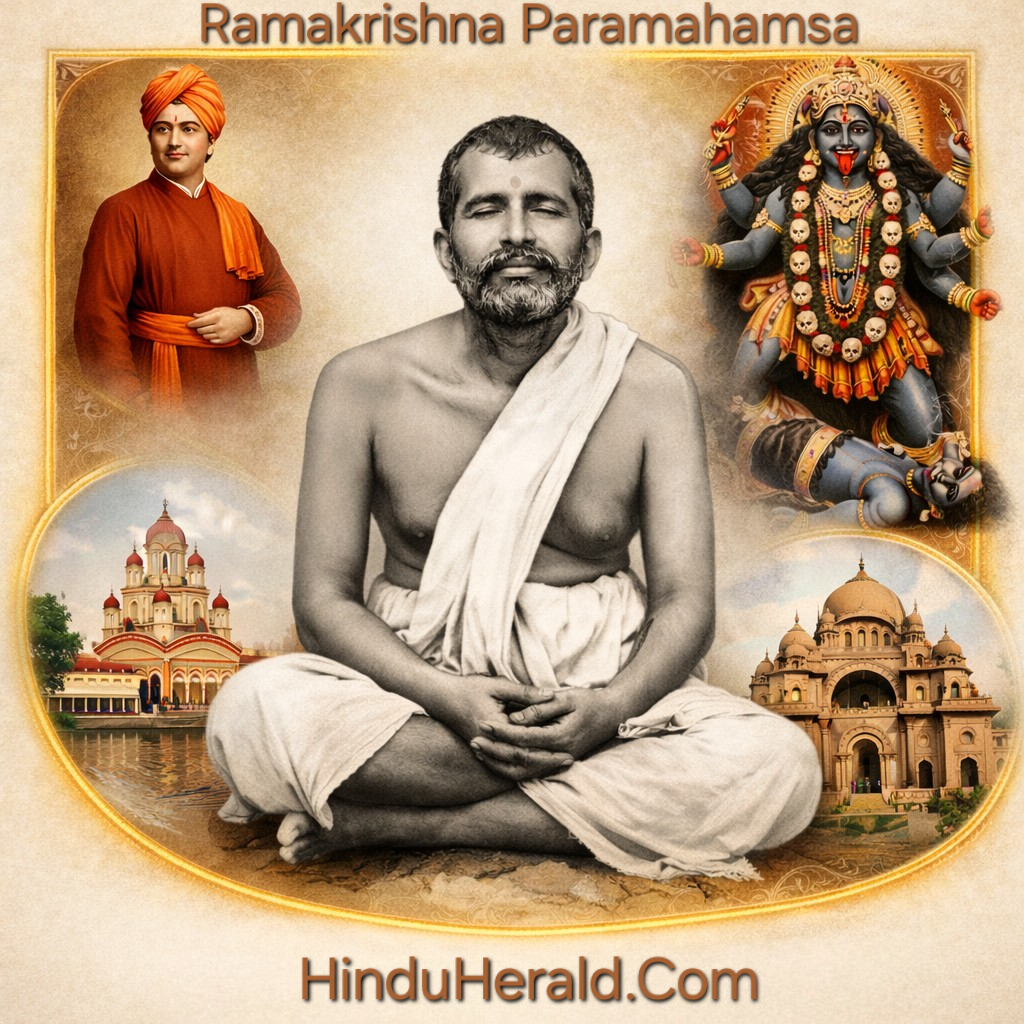
At 19, Ramakrishna became a priest at the Dakshineswar Kali Temple near Kolkata, built by Rani Rashmoni.
His job? Simple. Dress the Goddess. Offer food. Perform the daily rituals.
But Ramakrishna couldn’t do “simple.”
He saw Kali as his Mother — not a statue, not a symbol, but a living, breathing presence.
- He would feed Her first, then eat the leftover prasad.
- He’d argue with Her like a child argues with his mother.
- He’d weep uncontrollably if She didn’t “respond” fast enough.
One night, desperate for Her darshan, he grabbed a sword from the temple wall and prepared to kill himself:
“Mother, if You don’t show Yourself, I’ll cut my own throat right here.”
That’s when She appeared.
Ramakrishna later described it:
“The whole room was filled with light. Wave after wave of bliss. I saw the Mother — living, conscious, the Primordial Energy — playing in this universe. I was beside myself with joy.”
From that moment on, Kali was no longer a deity to him. She was his Mother. And She was real.
📜 Kali vision: The Gospel of Sri Ramakrishna, Chapter 1; Sri Ramakrishna: The Great Master
🔥 The Experiment No One Else Dared
Here’s what makes Ramakrishna shocking:
He didn’t just worship Kali. He tested every major religion to see if they all led to God.
Not intellectually. Not theoretically.
He practiced them — fully, completely, madly — until he had direct experience of their truth.
🕉️ Advaita Vedanta (Hindu Non-Dualism)
Under the guru Totapuri, Ramakrishna practiced the path of jnana yoga (knowledge). Totapuri taught him to see the universe as maya (illusion) and realize Brahman — the formless Absolute.
Ramakrishna succeeded. He entered nirvikalpa samadhi — a state where the ego dissolves completely into infinite consciousness.
He stayed in that state for six months straight, barely eating or moving. His body had to be force-fed to keep him alive.
☪️ Islam
A Sufi saint named Govinda Roy taught Ramakrishna the practices of Islam. Ramakrishna dressed in Muslim clothes, ate Muslim food, stopped going to the Kali temple, and prayed as Muslims do.
Within three days, he had a vision of Prophet Muhammad glowing with divine light. Ramakrishna felt the same ecstasy he felt with Kali.
✝️ Christianity
When he heard the Bible read aloud, Ramakrishna became obsessed with Jesus. He stopped eating, stopped worshipping Kali, and meditated only on Christ.
After three days, he had a vision of Jesus Christ merging into his own body.
💡 The Conclusion That Changed Everything
After experiencing God through Hinduism, Islam, and Christianity, Ramakrishna arrived at a truth that was revolutionary in 19th-century India:
“Jato mat, tato path.”
“As many faiths, so many paths.”
He didn’t mean all religions are “sort of true” or “basically the same.”
He meant:
Every authentic path leads to the same God — but the forms, the language, and the practices differ based on culture, temperament, and time.
- A Christian sees Christ.
- A Muslim sees Allah.
- A Hindu sees Kali or Krishna.
But the experience? Identical.
This wasn’t theological theory. It was lived proof.
📜 Religious experiments: The Gospel of Sri Ramakrishna; Sri Ramakrishna and His Divine Play by Swami Saradananda
🧑🎓 Enter Narendranath: The Atheist Who Became Vivekananda
In 1881, a cocky, sharp-tongued 22-year-old law student named Narendranath Datta came to Dakshineswar to challenge Ramakrishna.
Naren was a member of the Brahmo Samaj — a reformist Hindu movement that rejected idol worship, rituals, and “superstition.” He was a rationalist. An atheist. And he was sure this uneducated priest was a fraud.
But when Naren walked into the room, Ramakrishna looked at him and said:
“I know who you are. You are Nara, the eternal companion of Narayana. You have come to help me in my work.”
Naren was stunned. No one had ever spoken to him like that.
Over the next five years, Ramakrishna broke down every intellectual wall Naren had built. He didn’t argue. He didn’t debate.
He just showed Naren what God felt like.
By placing his hand on Naren’s chest, Ramakrishna would send him into spontaneous samadhi. Naren — the atheist, the skeptic — would lose all sense of his body and experience infinite consciousness.
When Ramakrishna died in 1886, Naren took sannyasa (renunciation) and became Swami Vivekananda — the man who would take Ramakrishna’s message to the entire world.
📜 Vivekananda’s meeting: The Gospel of Sri Ramakrishna; The Life of Swami Vivekananda by his Eastern and Western disciples
🌍 How a Dead Saint Conquered the World
Ramakrishna himself never left Bengal. He barely traveled outside Kolkata.
But Vivekananda did.
In 1893, Vivekananda represented Hinduism at the Parliament of the World’s Religions in Chicago. His opening words shocked the Western world:
“Sisters and brothers of America…”
The crowd erupted in applause. No speaker had ever addressed them with such warmth and equality.
Over the next few years, Vivekananda:
✅ Founded the Ramakrishna Mission (1897) — a humanitarian organization serving the poor, sick, and uneducated
✅ Established Vedanta Societies across the U.S. and Europe — teaching Advaita Vedanta to Western seekers
✅ Wrote and spoke tirelessly about practical Vedanta — spirituality that doesn’t run away from the world, but transforms it
Vivekananda died young — at just 39 — but by then, Ramakrishna’s vision had become global.
📜 Vivekananda’s mission: Complete Works of Swami Vivekananda
🏛️ Ramakrishna Math & Mission: What They Actually Do
Most people know Ramakrishna Math and Ramakrishna Mission exist. Few know what they do.
Ramakrishna Math (Founded 1899)
A monastic order of monks who have renounced worldly life to pursue spiritual realization and teach Vedanta.
- Monks take vows of celibacy, poverty, and service.
- They live in ashrams, meditate, study scripture, and guide seekers.
- Headquarters: Belur Math, West Bengal (Ramakrishna’s final resting place)
Ramakrishna Mission (Founded 1897)
A charitable organization dedicated to seva (selfless service).
What they do:
🏥 Hospitals & Clinics — Free or low-cost healthcare for the poor
🏫 Schools & Colleges — Education from primary to university level
📚 Libraries & Publishing — Spreading spiritual literature in multiple languages
🌾 Disaster Relief — Immediate response to floods, earthquakes, pandemics
👨🌾 Rural Development — Empowering villages with skills, clean water, sanitation
🧘 Spiritual Training — Meditation retreats, yoga centers, Vedanta classes
They operate in over 250 centers worldwide, from India to Argentina to Russia.
And here’s what shocks people:
The monks don’t preach. They serve.
Feed the hungry? That’s worship.
Educate the illiterate? That’s worship.
Heal the sick? That’s worship.
This is Ramakrishna’s Vedanta in action: Serve humanity as you would serve God — because they are God.
📜 Mission work: Official Ramakrishna Mission website; various biographies
📖 The Gospel of Sri Ramakrishna: The Book That Changes Lives
Unlike most Hindu saints, Ramakrishna’s teachings weren’t written by him.
They were recorded verbatim by his disciple Mahendranath Gupta (known as “M”), who attended Ramakrishna’s talks with a notebook and captured his exact words in Bengali.
The result? The Gospel of Sri Ramakrishna — over 1,000 pages of raw, unfiltered spiritual genius.
What makes it different:
✅ It’s not scripture — it’s conversation
✅ It’s not philosophy — it’s experience
✅ It’s not preaching — it’s stories, jokes, parables, and arguments
Ramakrishna speaks in simple language. He uses everyday examples:
- “God is like butter hidden in milk. You have to churn to get it.”
- “A devotee is like a kitten — the mother cat picks it up by the neck and carries it. But some people are like baby monkeys — they cling to the mother themselves.”
This book has converted atheists, inspired monks, and transformed seekers for over a century.
If you’ve never read it, start now.
📖 The Gospel of Sri Ramakrishna, translated by Swami Nikhilananda (available free online)
💀 Why Should You Care About Some Dead Saint?
Fair question.
Ramakrishna died in 1886. That’s 139 years ago. Why does he matter now?
Here’s why:
1) He proved religion isn’t just belief — it’s experience.
Ramakrishna didn’t believe in God.
He saw God. He spoke to Her. He touched Her.
And he taught others how to do the same.
In an age where religion is mocked as “superstition,” Ramakrishna is living proof that the Divine is real — not as a concept, but as an experience.
2) He showed that all religions are valid paths.
In a world torn apart by religious conflict, Ramakrishna’s life is the ultimate answer:
You don’t need to convert. You don’t need to fight. Just go deeper into your own tradition.
Christian? Go deeper into Christ.
Muslim? Go deeper into Allah.
Hindu? Go deeper into Kali, Krishna, Shiva — whoever calls you.
The destination is the same.
3) He made spirituality practical.
Ramakrishna didn’t say, “Renounce the world and go to a cave.”
He said:
“Do your duty in the world, but keep your mind on God. Be like a maidservant in a rich man’s house — she works all day, but her mind is on her own children back home.”
You don’t have to become a monk. You just have to remember.
4) His disciples actually did something.
Most gurus leave behind books and disciples who argue over interpretations.
Ramakrishna left behind an army of monks who feed the hungry, heal the sick, and educate the poor.
That’s not philosophy. That’s power.
🔱 The Final Truth
Ramakrishna didn’t write books.
He didn’t build temples.
He didn’t start political movements.
He just lived so close to God that everyone who met him could feel it.
And when he died, his disciples didn’t mourn.
They got to work.
Because Ramakrishna had shown them the truth:
God isn’t up in heaven, waiting to be pleased.
God is right here — in the beggar, the child, the sick, the suffering.
And serving them is the highest worship.
So on this Ramakrishna Jayanti, don’t just light a lamp and move on.
Read The Gospel.
Visit a Ramakrishna Mission center.
Volunteer. Donate. Serve.
Or just sit quietly and ask the same question Ramakrishna asked every day of his life:
“Mother, are You real?”
And wait.
Because if you ask sincerely — the way Ramakrishna did — She will answer.
🕉️ Jai Ramakrishna
🌺 Jai Ma Kali
© Hindu Herald. All rights reserved.
About the Author