🔥 Karthigai Deepam: Celebrating Shiva as a Blazing Pillar of Fire
By Hindu Herald Staff
Today is Karthigai Deepam, the Shaivite festival that honors Shiva’s incarnation as a blazing pillar of fire! Keep reading to discover the story of the pillar of fire, Brahma’s evil fifth head, Vishnu’s reward, and how a sacred hill in Tamil Nadu becomes a giant diya lamp of devotion each year.
🕊️ The Arrogance of Brahma, The Calm of Vishnu
In a time before temples, before scriptures, when divinity still walked like wind across the cosmos, Brahma came upon Vishnu resting on the coils of Adi Shesha. Offended, Brahma demanded that Vishnu rise and pay him homage. After all, he was the creator of the worlds.
But Vishnu opened his eyes and replied gently, “I am your source. You came from my navel. It is you who should bow to me.”
Their debate turned into battle. Cosmic weapons flew—flames, wheels, spears of light—and the very air trembled. The Devas watched in horror. If Creator and Preserver were at war, who could preserve them?
They turned to Mahadeva—to the One whose presence burns but does not consume, who arrives when pride outgrows wisdom.
🔥 The Flame Appears
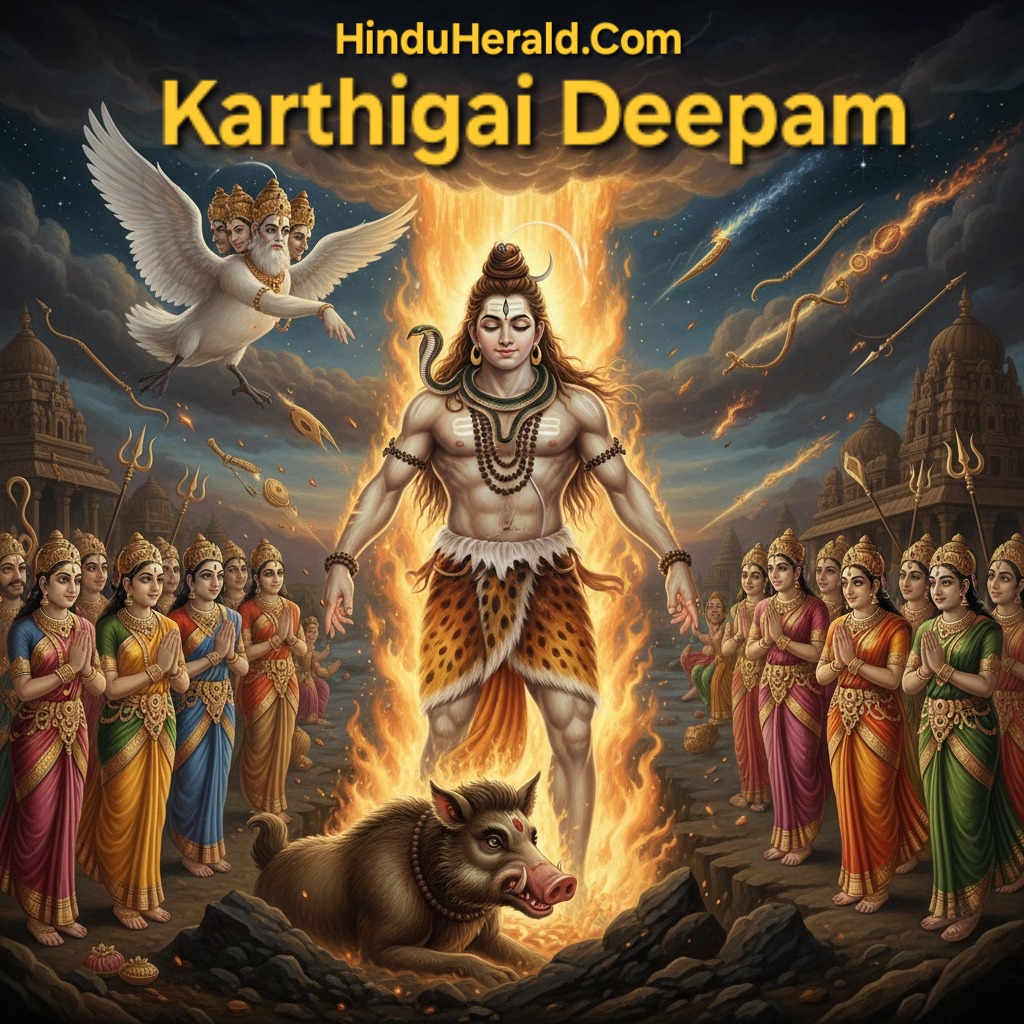
Lord Shiva went to the battlefield. Without a word, without a sound, Shiva manifested—not in form, but in essence. He did not take sides. He became a pillar of fire stretching beyond sight, beyond worlds, beyond time itself.
Every weapon hurled by Brahma and Vishnu vanished into the pillar of fire’s brilliance.
The gods fell silent. The battle ceased.
Brahma and Vishnu stared at the column of light, baffled. What was this? Where did it begin? Where did it end?
They agreed to a challenge: whoever found one end of the flame would be declared Supreme.
Brahma took the form of a swan and flew upward.
Vishnu transformed into a boar (Varaha) and burrowed deep below.
They agreed to meet back at the center of the pillar of fire.
🦢 The Lie of the Swan, The Truth of the Boar
Vishnu dug through oceans and netherworlds, his snout covered in the mud of forgotten realms. But he found no base. Exhausted, he returned and admitted, “I could not find the bottom. This fire is beyond me.”
Meanwhile, Brahma flew for what felt like eternity. Still no top. But then he saw something fall—a Ketaki flower, drifting slowly downward. The blossom had once been offered to Shiva and had fallen from his crown.
Brahma saw an opportunity.
“Help me,” he said. “If you testify that I reached the top, I shall win.”
The flower agreed.
Brahma returned with the Ketaki and lied to Vishnu, saying, “I reached the top. This flower is proof.”
Vishnu, sincere and respectful, offered a garland of worship to Brahma.
⚡ Shiva Emerges: Truth and Judgment
The pillar of fire split open.
Shiva stepped forth, blazing and beautiful, with ash upon his skin and galaxies in his hair.
He looked at Vishnu and smiled:
“You spoke the truth, though it humbled you. You shall be worshipped with devotion equal to mine. Your temples, festivals, and devotees shall be many.”
He turned to Brahma with eyes like lightning.
“You lied for honor. But honor cannot be stolen. You shall never be worshipped with temples or festivals.”
Shiva then created Bhairava, a fierce form of himself, from between his brows. Bhairava rose like a storm and severed Brahma’s fifth head—the one that had spoken falsehood.
Vishnu stepped forward and pleaded, “Enough. He has been punished. Let mercy follow justice.”
Shiva relented.
Brahma, humbled, did not complain. Instead, he folded his hands and said, “Even this is a blessing. Let your will be done.”
Shiva, moved, gave him two boons:
- He made Brahma the administrator of the universe.
- And declared that no Vedic yajna (sacrifice) would be complete without first invoking Brahma.
Finally, Shiva turned to the Ketaki flower and cursed her:
“You shall never again be used in my worship.”
The flower wept. “Then my birth is fruitless.”
Shiva relented once more. “You may still be used to decorate the canopy above my murti. My attendants and devotees may wear you—but not for puja.”
And so the pillar of flame disappeared, but its story burned itself into eternity.
Source: Shiva Purana, Vidyeshvara Samhita, Chapters 6–8.
👹 Shiva’s Mercy & Brahma’s Evil Fifth Head
You might be wondering: wasn’t it harsh for Shiva to send Bhairava to sever Brahma’s head?
Imagine if you had a second head—only it constantly insulted people, encouraged you to lie, and picked fights with those wiser than you. It embarrassed you. It got you into trouble. That was Brahma’s fifth head—the arrogant one.
- It insulted Vishnu.
- It provoked war.
- It convinced the Ketaki flower to lie.
Shiva didn’t destroy Brahma. He simply removed the part of him that had become corrupt. It was surgical mercy, not destruction. Even Brahma recognized it as a blessing, calling Bhairava’s act a boon.
This wasn’t cruelty. It was compassion—a divine reset.
✝️ God as a Pillar of Fire in the Bible
The idea of God manifesting as a pillar of fire appears in multiple traditions. In the Bible, when the Israelites fled Egypt, they wandered the desert for 40 years. During this journey, God guided them as a pillar of cloud by day and a pillar of fire by night, lighting their path through the wilderness.
“And the Lord went before them by day in a pillar of a cloud, to lead them the way;
and by night in a pillar of fire, to give them light.”
— Exodus 13:21 (KJV)
Interestingly, the story of Lord Shiva manifesting as an infinite pillar of fire is found in the Shiva Purana, a scripture that predates the Biblical Old Testament by many centuries. While the theological meanings differ, both traditions preserve the awe-inspiring symbol of the Divine as Light—uncontainable, mysterious, and guiding.
In Tamil Shaivism, the flame silenced ego and revealed the truth. In the Biblical tradition, it offered direction through darkness. Across civilizations, the fire of God remains a beacon.
🪔 The Celebration of Karthigai Deepam
This divine event of Lord Shiva’s incarnation as a pillar of fire is remembered as Karthigai Deepam, one of Tamil Nadu’s most sacred festivals.
🌄 Arunachala—the Hill That Is Shiva
In Tiruvannamalai, devotees believe the Arunachala Hill itself is the fire-linga from this very legend. It is not a place where Shiva appeared. It is Shiva.
For ten days leading up to the festival, the town comes alive with deepams (lamps), processions, and chants. The temple’s deities are paraded on grand vahanas, and deepams are lit along every street, doorstep, and temple wall.
On the night of Karthigai Deepam:
- A massive cauldron of ghee and wicks is lit at the top of Arunachala Hill.
- The flame can be seen for miles—a visible symbol of the pillar of fire that once silenced the gods.
- Devotees chant “Annamalaiyarukku Arohara!” with arms raised and eyes filled with tears.
Lighting lamps in one’s home is not mere tradition—it is a quiet act of remembrance. A way of saying: “Let my ego be burned too. Let me honor what is beyond me.”
🎉 How Karthigai Deepam Is Celebrated in Temples and Homes Around the World
🛕 In Temples
Shaivite temples in India, Sri Lanka, Malaysia, Singapore, the UK, the US, Canada, and beyond celebrate Karthigai Deepam with special pujas, Vedic chanting, processions of Shiva and Murugan, and rows of oil lamps lining the temple walls and walkways. Many temples light a large flame atop the gopuram, symbolizing Shiva’s eternal jyoti.
🏠 In Homes
Devotees clean their homes, decorate entrances with kolams (rangoli), and light rows of deepams in windows, balconies, doorsteps, and altars. Some observe a fast, offer naivedyam, or chant Shiva mantras. Lighting these lamps is not just symbolic—it invites inner illumination, burns away ego, and honors Shiva as jyoti swarupa.
Wherever it’s celebrated, Karthigai Deepam turns every home and temple into a sanctuary of flame and faith.
✅ What Karthigai Teaches Us
- Truth is greater than victory.
- Humility is honored more than pride.
- The Supreme reveals himself not to the clever, but to the sincere.
Even gods must bow before Truth. And the Flame that has no beginning and no end is still burning—at Arunachala, in the lamp on your altar, and in the heart that seeks Shiva.
Happy Karthigai Deepam!
Copyright © Hindu Herald
About the Author